
- September 22, 2026
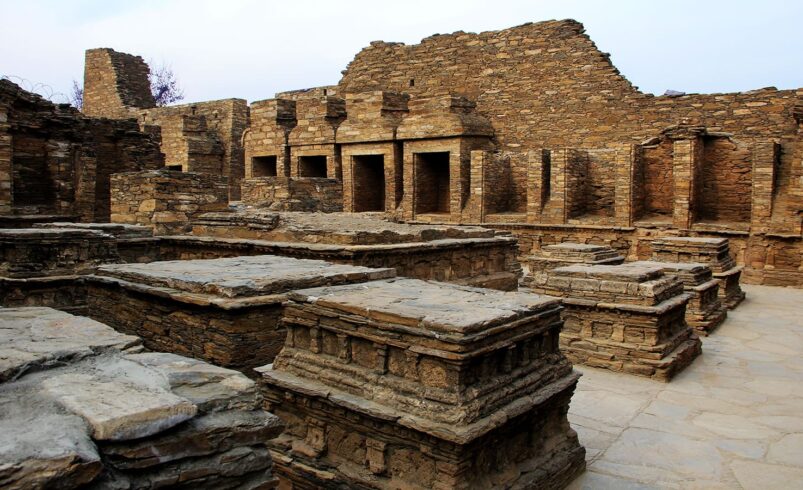
A Chinese monk documented Takht-i-Bahi’s main stupa as already damaged when he passed through in the 7th century. That stupa is still standing today. It’s genuinely one of the best-preserved Buddhist monastic complexes anywhere in the world, saved by nothing more than its hilltop position.
Takht-i-Bahi: overview
| Detail | Takht-i-Bahi |
|---|---|
| Founded | Early 1st century CE |
| Abandoned | Roughly 7th century CE |
| Location | Near Mardan, Khyber Pakhtunkhwa |
| Coordinates | 34°17′10″N 71°56′48″E |
| UNESCO status | World Heritage Site since 1980 |
| Area | 33 hectares |
| Hill height | Roughly 150 meters above the surrounding plains |
What the name means
Takht-i-Bahi translates roughly to “Throne of the Water Spring,” or in some readings, “Throne of Origins.” “Takht” means throne or summit, and “Bahi” refers to water or spring. Together they describe the site’s position atop a steep slope where springs once flowed.
Why it survived when so much else didn’t
- A defensible hilltop: the monastery’s remote, elevated position genuinely kept it safe through waves of invasion that destroyed many other Gandhara Buddhist sites in the 5th and 6th centuries.
- Gradual abandonment, not destruction: Takht-i-Bahi wasn’t violently razed. It was slowly abandoned as Buddhism declined in the region, roughly by the 7th century CE.
- Documented in transit: the Chinese monk-pilgrim Xuanzang passed through the region between 629 and 645 CE searching for Buddhist texts, and recorded the site’s main stupa, by his account already the most spectacular he’d seen, though already damaged even then.
- Rediscovered in 1836: the first modern mention came from General Court, a French officer serving Maharaja Ranjit Singh.
What’s actually there
- The main stupa court: the monastery’s central and most significant structure.
- A group of three stupas: smaller devotional structures surrounding the main court.
- A conference hall: used for communal monastic gatherings.
- Secular buildings: structures supporting the monastery’s daily, practical operations.
- A votive stupas court: genuinely dense with smaller commemorative stupas.
- Construction technique: stone blocks laid in the distinctive Gandhara “diaper style,” set in lime and mud mortar, still visible today.
Who actually damaged the site
- The Huns, by name: the destruction wave that hit Gandhara in the mid-5th century is genuinely attributable to specific rulers, the Hun leader Toramana and his son Mihirakula, who killed many inhabitants and destroyed most Buddhist monasteries in the region.
- Excavations began in 1864: formal archaeological work started well before the 20th century, with a major restoration following in the 1920s.
- Artifacts abroad: a significant number of objects from the site, including a well-known stair-riser depicting devotees in Hellenistic costume, are now held in the British Museum.
- A second theory on the name: beyond the “water spring” reading, some scholars trace “Bahi” to Arabic, where it can mean an abandoned, empty house, suggesting Takht-i-Bahi may describe “a castle where no king remains.”
Sahr-i-Bahlol: the second half of the listing
UNESCO’s official inscription covers two sites together. Takht-i-Bahi and the nearby ruins of Sahr-i-Bahlol, a small fortified city from the same era, are both included. Genuinely important to know: most of the original sculpture and artifacts recovered from Takht-i-Bahi were relocated to the Peshawar Museum. A significant inscription from the Gondophares period is preserved separately in the Lahore Museum.
How to reach Takht-i-Bahi
The site sits roughly 80 km northwest of Peshawar and 15 to 16 km from Mardan, in Khyber Pakhtunkhwa. It’s a genuinely manageable day trip from Peshawar. A well-maintained approach road leads in, followed by a walk up stone stairs to the hilltop complex.
Frequently asked questions
Why is Takht-i-Bahi a UNESCO World Heritage Site?
Inscribed in 1980, it’s recognized as one of the most imposing relics of Buddhism anywhere in the ancient Gandhara region. It’s also genuinely well preserved.
What does Takht-i-Bahi mean?
Roughly “Throne of the Water Spring,” describing its hilltop position near springs that once flowed on the slope.
How old is Takht-i-Bahi?
Founded in the early 1st century CE. It remained in active use as a Buddhist monastic center until roughly the 7th century.
How do I get to Takht-i-Bahi?
It’s roughly 80 km from Peshawar and 15 to 16 km from Mardan, a genuinely manageable day trip from Peshawar.
Why did Takht-i-Bahi survive so well when other Gandhara sites didn’t?
Its remote, elevated hilltop position kept it safe from successive waves of invasion. It was gradually abandoned rather than destroyed.