






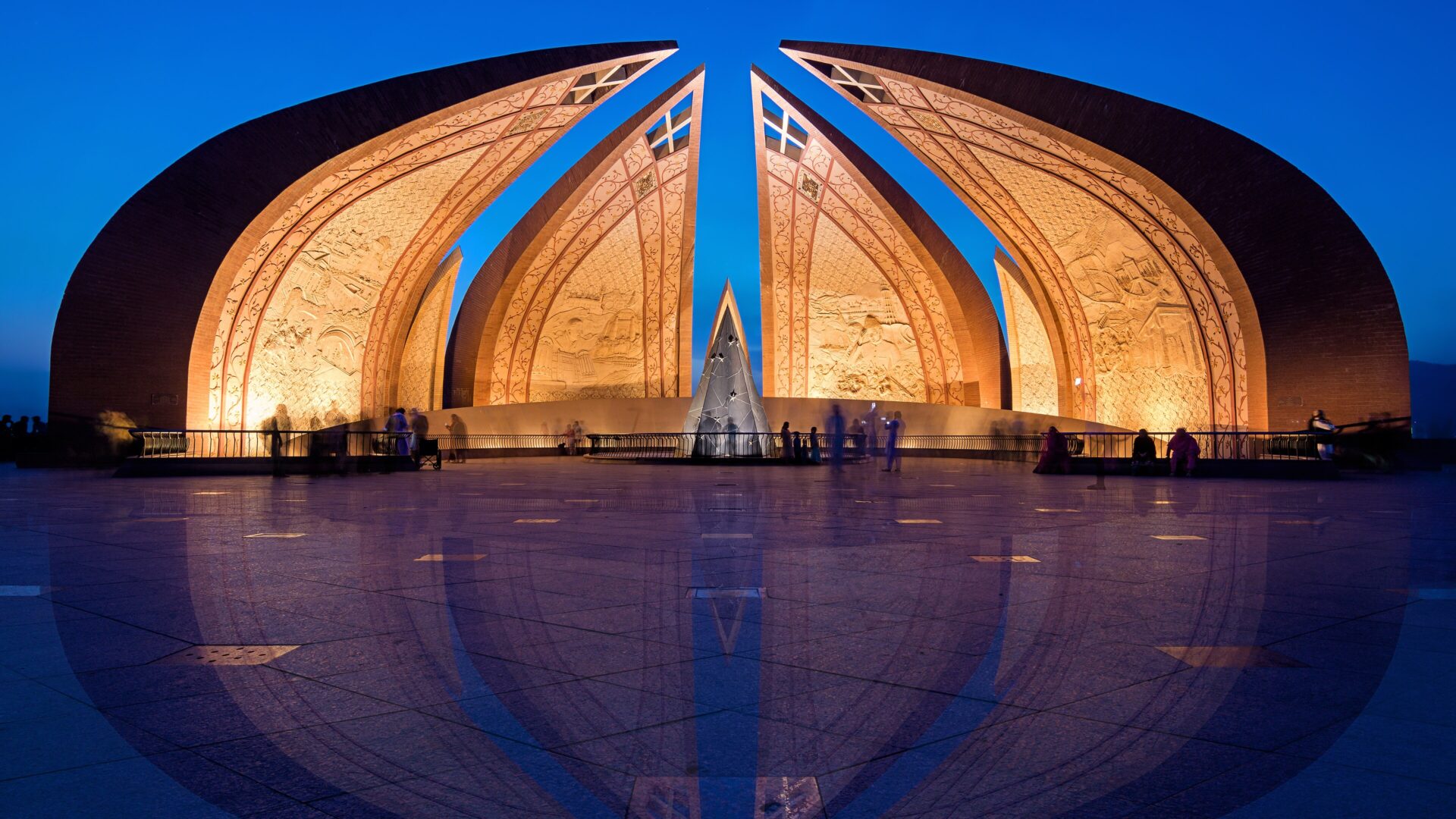
The Pakistan Monument is a national landmark on the Shakarparian Hills in Islamabad. Its granite petals rise like a blooming flower. From above, the layout also looks like the star and crescent of the national flag. It opened on 23 March 2007. The hilltop location makes it visible from across Islamabad and Rawalpindi, and a small museum sits beside it. This guide covers what the design means, its history, how to get there, and what to do nearby.
Quick answer: what is the Pakistan Monument?
The Pakistan Monument, also called Yadgar-e-Pakistan, is a national monument and heritage museum in Islamabad. The architect Arif Masood designed it. The foundation stone was laid on 25 May 2004, and President Pervez Musharraf inaugurated it on 23 March 2007. It covers 2.8 hectares. Four large petals and three small petals rise from a central platform. Ask at the gate about current entry rules and opening hours.
Pakistan Monument quick facts
| Detail | Pakistan Monument |
|---|---|
| Location | Western Shakarparian Hills, Islamabad |
| Coordinates | 33.6935° N, 73.0683° E |
| Foundation stone | 25 May 2004 |
| Inaugurated | 23 March 2007 |
| Architect | Arif Masood (artwork by Guchrung) |
| Area | 2.8 hectares |
| Height | About 18 m (58 ft) |
| Materials | Granite petals, stainless steel crescent, black granite star |
| Museum | Pakistan Monument Museum, with wax figures |
| Owner | Ministry of Culture |
| Visitors | About 570,000 in 2015 |
| Best season | March to April and October to November |
Where is the Pakistan Monument?
The monument stands on the western side of the Shakarparian Hills in Islamabad. The hill gives it a view over the city. The monument and its museum sit inside a landscaped park that locals use for family outings.
What does the Pakistan Monument represent?
The monument stands for the unity of the Pakistani people. It honours those who gave up the present for a better future. The petals are the main symbol. Many guides say the four large petals stand for the four provinces, and the three small petals stand for three territories: Gilgit-Baltistan, Azad Kashmir and the tribal areas.
The design notes summarised on Wikipedia give a slightly different reading. They say the four large petals stand for four cultures: Punjabi, Balochi, Sindhi and Pakhtun. So sources differ, and both readings are in common use. The petal shape itself comes from the muqarnas of Mughal architecture. The architect explains it this way: “We should learn from history but not remain in it.”
History of the Pakistan Monument
The Ministry of Culture organised a national design competition through the Pakistan Council of Architects and Town Planners. The theme was the strength, unity and dedication of the Pakistani people. The competition drew 21 entries, and three were shortlisted. Arif Masood’s design was approved on 10 July 2003.
The foundation stone was laid on 25 May 2004. The structure was finished in 2006. President Pervez Musharraf opened it on 23 March 2007, which is Pakistan Day, when the country marks the Lahore Resolution of 1940. Syed Mahmud Khalid was the engineer who supervised the project.
Pakistan Monument design and structure
From above, the monument looks like a star and crescent. The four large petals and three small petals are made of granite. Their inner walls carry murals that tell the story of the nation. A five-pointed star of black granite forms the central platform, and water surrounds it. A metal crescent circles the star. It is inscribed with sayings of Muhammad Ali Jinnah and verses by Allama Iqbal.
How tall is the Pakistan Monument?
Wikipedia lists the height as about 18 metres, or 58 feet. The hilltop setting is what makes it visible from far away.
How to reach the Pakistan Monument
The monument is on a hill in central Islamabad. It is a ride from most central areas.
Nearest airport
Islamabad International Airport is the main airport. It lies well outside the city, so allow time for the drive. Taxis and ride-hailing cars run from the terminal.
Nearest railway station
Islamabad Railway Station serves the capital. Rawalpindi Railway Station is the larger hub nearby. Check Pakistan Railways for timetables.
Road access
A road climbs the Shakarparian Hills to the monument. Ride-hailing cars and taxis can take you to the entrance. Driving yourself also works, but check parking on arrival. Our Public Transport Guide for Pakistan explains other options.
Best time to visit
Spring and autumn are the best seasons, roughly March to April and October to November. Islamabad gets hot before the monsoon, and heavy rain can fall in July and August. Winter mornings are cool. Late afternoon is ideal because the light softens and the city view opens up. The monument is also lit at night. For more on seasons, see our Best Time to Visit Pakistan guide.
Weather
Islamabad sits at the foot of the Margalla Hills. Summers are hot and humid. Winters are cool, with some rain. Check the forecast before you go, and bring a light rain jacket in July and August.
Places to visit
- The petals and platform. Walk inside the petals to see the murals.
- The crescent inscriptions. Read the sayings and verses on the metal crescent.
- The Pakistan Monument Museum. It has wax figures of key events in the nation’s story.
- The hilltop view. Look out over Islamabad and, on clear days, toward Rawalpindi.
Lesser-known details to look for
- Seen from above, the petals and platform form the star and crescent.
- The petal form is based on Mughal muqarnas, reworked with modern materials.
- The murals are the work of a team of artists. One account says they spent about 119,000 hours on them.
- The monument is dedicated to national unity, not to one person or event.
Things to do nearby
- Tour the monument and the museum.
- Visit Lok Virsa, the heritage museum, which is also in the Shakarparian area. Check hours first.
- Have a picnic in the park.
- Pair it with Daman-e-Koh and Faisal Mosque. See our top 10 places to visit in Islamabad.
Adventure activities
There are no adventure activities at the monument itself. The Margalla Hills, however, have walking trails a short drive away. See our hiking guides for ideas, and check trail rules and weather first.
Photography spots
- Front view with the petals in frame. A wide lens works best.
- Between the petals. Frame the city or the sky through the gaps.
- Blue hour. Just after sunset, the sky turns deep blue and the monument lights come on.
- The crescent and star. Shoot details of the inscriptions and the granite.
Flying a drone near national monuments usually needs official permission. Check the rules first.
Where to stay
Islamabad has hotels from mid-range to luxury. See our Best Hotels in Islamabad guide for options.
What to eat
Islamabad has many restaurants, from casual cafes to upscale dining. Our list of the best restaurants in Islamabad is a good start. Street food is also easy to find, so read our street food safety tips first.
Transportation
Ride-hailing apps and taxis are the easiest way around Islamabad. Agree on the fare first if you hail a street taxi. For the wider picture, read our public transport guide.
Estimated costs (PKR)
Prices change often, so this page gives no fixed rupee amounts. Reports in 2012 said entry was no longer free. Use the table as a planning checklist and confirm costs at the gate.
| Item | What to expect |
|---|---|
| Monument entry | Confirm the current ticket price at the gate. |
| Museum | Ask whether it needs a separate ticket. |
| Ride from central Islamabad | Varies by distance and traffic. Use the fare shown in the app. |
| Food and drink | Cafes cost more than street food. |
Packing checklist
- Comfortable walking shoes for the hill paths
- Water bottle and sun protection
- Light rain jacket in the monsoon months
- A light jacket for winter evenings
- A camera or phone with a wide lens
- A copy of your ID, in case of checkpoints
Travel tips
- Go in the late afternoon and stay for the lights.
- Combine it with Daman-e-Koh and Faisal Mosque for a full Islamabad day.
- Check opening hours and ticket rules at the gate.
- Weekends and holidays are busier.
- New to Pakistan? Read our 45 things to know before travelling to Pakistan.
Safety tips
- Keep normal city precautions and watch your bag in crowds.
- Expect security checks at busy sites.
- Stay on the marked paths on the hill.
- Use registered taxis or ride-hailing apps at night.
- For wider advice, see Is Pakistan Safe to Visit?.
Responsible tourism
- Keep the park clean and use the bins.
- Do not climb on the petals or the water features.
- Dress modestly and be considerate when taking photos.
- Respect what the monument means to many Pakistanis.
Emergency contacts in Islamabad
| Service | Number |
|---|---|
| Police | 15 |
| Rescue 1122 | 1122 |
| Edhi ambulance | 115 |
| Fire brigade | 16 |
Canada’s travel advice for Pakistan lists the same police, medical and fire numbers. Save them before you travel.
Attractions nearby
- Daman-e-Koh and the Margalla Hills. Viewpoints and trails above the city.
- Faisal Mosque. Islamabad’s best-known mosque.
- Lok Virsa Museum. Pakistan’s folk heritage, in the same hill area.
- City guide. See our Islamabad travel guide.
Possible half-day itinerary
| Time | Plan |
|---|---|
| Late morning | Lok Virsa Museum. Check opening times first. |
| Early afternoon | Pakistan Monument and museum. |
| Late afternoon | Daman-e-Koh viewpoint. |
| Evening | Faisal Mosque, then dinner. |
Pakistan Monument FAQs
What does the Pakistan Monument represent?
It stands for the unity of the Pakistani people. Sources read the petals as four provinces and three territories, or as four cultures.
Who designed the Pakistan Monument?
The architect Arif Masood designed it. Its artwork is credited to Guchrung.
When did the Pakistan Monument open?
President Pervez Musharraf inaugurated it on 23 March 2007.
How many petals does the Pakistan Monument have?
Seven: four large petals and three smaller ones.
Is there a museum at the Pakistan Monument?
Yes. The Pakistan Monument Museum sits beside the monument and has wax figures of key events.
Is the Pakistan Monument free to enter?
Reports in 2012 said entry was no longer free. Confirm the current price at the gate.
How long should I spend at the Pakistan Monument?
One to two hours is enough for the monument, the museum and the view.
When is the best time to visit the Pakistan Monument?
Spring or autumn, in the late afternoon.
Final thoughts on visiting the Pakistan Monument
The Pakistan Monument is easy to visit and rewarding to photograph. Go in the late afternoon, read the inscriptions, and stay for the view and the lights. Confirm tickets and hours at the gate. For more on the design and history, see the Pakistan Monument article on Wikipedia.