


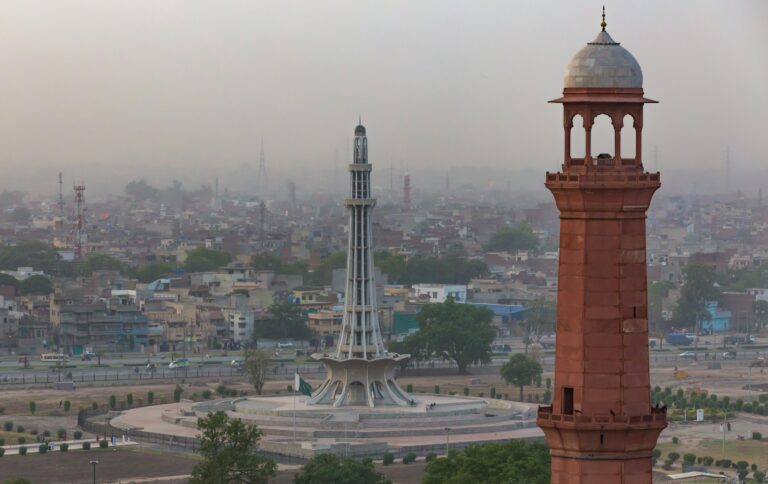
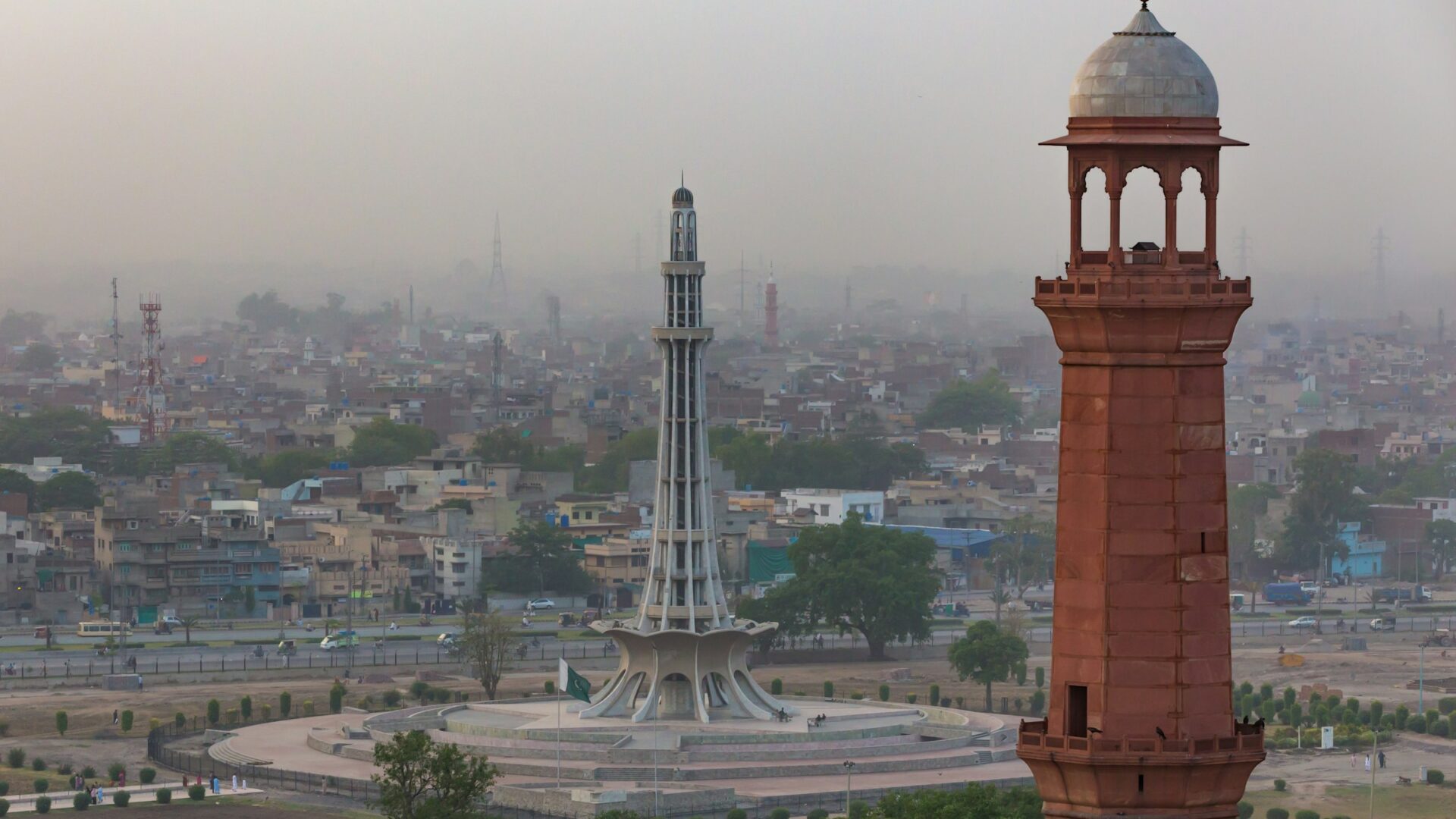
Minar-e-Pakistan is the tall marble-and-concrete tower in Lahore’s Greater Iqbal Park. It marks the place where the Lahore Resolution was passed on 23 March 1940. That resolution was the first formal call for a separate homeland for the Muslims of British India. Today the tower is one of Pakistan’s best-known national monuments. It stands close to the Badshahi Mosque and Lahore Fort, so most visitors see all three together. This guide covers the history, design, height, how to get there, and what to do nearby.
Quick answer: what is Minar-e-Pakistan?
Minar-e-Pakistan is Urdu for “Tower of Pakistan”. It is a national monument in Lahore, Punjab. Work began on 23 March 1960, and most sources say the tower was finished in 1968. Nasreddin Murat-Khan, a Russian-born architect who made his career in Pakistan, designed it. Most sources give its height as about 70 metres, which includes the raised base. The monument sits in an open park, so it is easy to visit. Ask at the gate about current entry rules and tower access.
Minar-e-Pakistan quick facts
| Detail | Minar-e-Pakistan |
|---|---|
| Location | Greater Iqbal Park, Circular Road, Lahore, Punjab |
| Coordinates | 31.5925° N, 74.3095° E |
| Built | 1960 to 1968 |
| Designer | Nasreddin Murat-Khan |
| Height | About 70 m including the base; some sources say about 60 m |
| Materials | Reinforced concrete with marble and stone |
| Also called | Tower of Pakistan, Yadgar-e-Pakistan |
| Commemorates | The Lahore Resolution of 23 March 1940 |
| Nearby | Badshahi Mosque, Lahore Fort, the Walled City |
| Best season | November to March |
Where is Minar-e-Pakistan?
The tower stands in the middle of Greater Iqbal Park, close to Lahore’s Walled City. The park was once called Minto Park. It was later renamed after the poet Allama Muhammad Iqbal. The Badshahi Mosque and Lahore Fort are a short distance away.
History of Minar-e-Pakistan
In the 1930s, Muslim leaders in British India debated how to protect Muslim political rights. On 23 March 1940, the All-India Muslim League met at Minto Park in Lahore. It passed the Lahore Resolution, which was later called the Pakistan Resolution. The resolution asked for Muslim-majority areas in the north-west and east of India to form independent states. Pakistan was created seven years later, in 1947. Pakistanis now mark 23 March as Pakistan Day.
A memorial was planned for the exact spot. The foundation stone was laid on 23 March 1960. Building took about eight years, and most sources say the tower was done in 1968. A few accounts give slightly different completion dates.
Nasreddin Murat-Khan designed and supervised the work. He was a Russian-born architect and engineer who built his career in Pakistan. For a time, the tower was also called Yadgar-e-Pakistan, or the Pakistan Resolution Memorial.
Minar-e-Pakistan design and structure
The tower blends Mughal and Islamic ideas with modern building methods. It rises from a raised base of about 8 metres. From that base, eight petal-like forms curve upward like an opening flower. The tower then narrows to a steel dome and pinnacle.
The base platform is shaped like a five-pointed star, and crescent-shaped pools surround it. Some visitors see the star and crescent of the national flag in this layout. The frame is reinforced concrete poured on site. Marble and stone cover the floors and walls. One account says the rougher stone near the bottom recalls the hard early years of the freedom struggle. The finer marble higher up stands for later success.
How tall is Minar-e-Pakistan?
Sources do not agree. Many give a height of 70 metres, or about 230 feet, counting the raised base. Others give about 62 metres for the tower alone. Archnet, the database of the Aga Khan Trust for Culture, lists roughly 60 metres overall. If you need one number, say “about 70 metres including the base” and note that sources vary.
How to reach Minar-e-Pakistan
Most visitors arrive by road from elsewhere in Lahore. The park is near the Walled City, and the tower is easy to spot once you are close.
Nearest airport
Allama Iqbal International Airport is Lahore’s main airport. It is some distance from the Walled City, so allow extra time for the ride. Taxis and ride-hailing apps run from the terminal.
Nearest railway station
Lahore Junction is the city’s main railway station. Check the Pakistan Railways website for current timetables before you book.
Road access
The park sits along Circular Road. Traffic can be heavy, and events sometimes close nearby roads. A taxi or ride-hailing car is easier than driving yourself, because parking near the Badshahi Mosque area can be tight. Our Public Transport Guide for Pakistan explains other ways to get around.
Best time to visit
November to March is the most comfortable season. Summer heat in Lahore often reaches the low 40s °C in May and June. Monsoon rain arrives in July and August. Evenings are pleasant in most seasons, and the tower is lit at night. Expect larger crowds around 23 March, when Pakistan Day events take place. For more on seasons, see our Best Time to Visit Pakistan guide.
Weather
Winters are cool and can bring morning fog. Summers are hot and dry until the monsoon. Check the forecast before you go. From April to September, carry water and use sun protection.
Places to visit
- The tower and petal base. Walk around it slowly to see how the shape changes.
- Greater Iqbal Park. The park has wide lawns and pools, and it is a good place to rest.
- The inscriptions. Plaques and inscriptions link the monument to the Pakistan movement.
- The viewing level. Some accounts mention stairs and a lift to a viewing level. Access can change, so ask at the gate.
Lesser-known details to look for
- The star-shaped platform and crescent pools are easiest to read from above or on a site plan.
- The stone changes from rough at the base to polished higher up.
- The park’s older name, Minto Park, links the site to its colonial past.
- Early morning is quiet, and local walkers share the paths with few tourists.
Things to do nearby
- Walk the park and read the monument’s story.
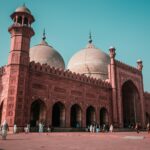
- Visit the Badshahi Mosque and Lahore Fort on the same day. Our guide to the Badshahi Mosque and Shahi Qila has details.
- Come back after dark to see the tower lit.
- Try Walled City food. See our Lahore food streets guide.
Adventure activities
There are no adventure activities at the monument itself. For an active day in Lahore, try a long walk through the Walled City lanes. If you want real adventure, Pakistan’s north is the place. Start with our trekking guides.
Photography spots
- Wide shot from the lawns. Put the tower in the centre and include the pools.
- Low angle at the base. This shows the petal shapes well.
- Golden hour and evening. The light is softer, and the tower is lit after dark.
- Park edge toward the Badshahi Mosque. Try to frame the mosque minarets beside the tower.
Flying a drone near national monuments usually needs official permission. Check the rules first, and respect other visitors’ privacy.
Where to stay
Lahore has hotels for most budgets, from simple guesthouses to luxury properties. If you want an easy heritage day, pick a hotel with quick road access to the Walled City. Our Best Hotels in Lahore guide lists options.
What to eat
The Walled City is the main food area. Our Lahore food streets guide covers where locals eat. Choose busy stalls, drink bottled water, and read our street food safety tips first.
Transportation
Ride-hailing apps and taxis work well in Lahore. Agree on the fare before you start if you use a street taxi. Buses and trains are also an option for longer trips.
Estimated costs (PKR)
Prices change often, so this page gives no fixed rupee amounts. Use the table as a planning checklist and confirm costs locally.
| Item | What to expect |
|---|---|
| Park and monument entry | Ask at the gate. Fees and rules can change. |
| Tower access | Confirm on the day whether it is open and whether a ticket is needed. |
| Ride from central Lahore | Varies by distance and traffic. Use the fare shown in the app. |
| Food and drink | Street food is usually the cheapest option. |
| Nearby sites | Lahore Fort and other sites have their own fees. Check each one. |
Packing checklist
- Comfortable walking shoes
- Water bottle and sun protection
- Light, modest clothing
- A scarf or shawl if you will enter the Badshahi Mosque
- Power bank and a little cash in small notes
- A copy of your ID
Travel tips
- Go in the late afternoon and stay into the evening. The heat eases, and you see the lit tower.
- Pair it with the Badshahi Mosque and Lahore Fort to make a full heritage day.
- Check for events. Rallies and public gatherings sometimes use the open space.
- Keep small change for tickets and snacks.
- New to Pakistan? Read our 45 things to know before travelling to Pakistan.
Safety tips
- Crowds can be large on national days and during events. Keep your bag close and your phone out of easy reach.
- Avoid large political gatherings if you are unsure of the situation.
- Use registered taxis or ride-hailing apps at night.
- For wider advice, see Is Pakistan Safe to Visit?.
Responsible tourism
- Keep the park clean and use the bins.
- Do not climb on the structure or the pools.
- Dress modestly and be polite when taking photos, especially near families.
- Respect the monument. It stands for a serious moment in national history.
Emergency contacts in Lahore
| Service | Number |
|---|---|
| Police | 15 |
| Rescue 1122 (Punjab) | 1122 |
| Edhi ambulance | 115 |
| Fire brigade | 16 |
These match the Lahore Police helpline list. Save them before you travel.
Attractions nearby
- Badshahi Mosque and Lahore Fort. See our Badshahi Mosque guide.
- Walled City of Lahore. Narrow lanes, old gates and busy bazaars.
- More history. Our top historical places in Lahore lists other stops.
- City overview. Read Discover Lahore for the wider picture.
Possible one-day itinerary
| Time | Plan |
|---|---|
| Morning | Lahore Fort (Shahi Qila). Check opening times on the day. |
| Midday | Badshahi Mosque. Dress modestly and remove your shoes. |
| Late afternoon | Greater Iqbal Park and Minar-e-Pakistan. Walk the grounds and take photos. |
| Evening | Watch the tower light up, then have dinner at a Walled City food street. |
Minar-e-Pakistan FAQs
How tall is Minar-e-Pakistan?
About 70 metres including the raised base, according to most sources. Some give about 60 metres, so figures vary.
Who designed Minar-e-Pakistan?
Nasreddin Murat-Khan, a Russian-born architect and engineer who worked in Pakistan, designed and supervised it.
When was Minar-e-Pakistan built?
Work began on 23 March 1960. Most sources say it was finished in 1968.
Why was Minar-e-Pakistan built there?
It stands on the site where the All-India Muslim League passed the Lahore Resolution on 23 March 1940.
Can you go up Minar-e-Pakistan?
Some accounts mention stairs and a lift to a viewing level. Access can change, so ask at the gate on the day.
Is Minar-e-Pakistan free to enter?
Entry rules and fees can change. We could not confirm a current fee, so check at the gate.
How long should I spend at Minar-e-Pakistan?
One to two hours is enough for the tower and park. Add half a day if you also visit the Badshahi Mosque and Lahore Fort.
What is the best time for photos at Minar-e-Pakistan?
Late afternoon and evening. The light is softer, and the tower is lit after dark.
Final thoughts on visiting Minar-e-Pakistan
Minar-e-Pakistan is more than a landmark. It marks a turning point in the story of Pakistan. It is easy to reach, pleasant to walk around, and close to Lahore’s greatest Mughal sites. Plan a late-afternoon visit, stay for the lights, and confirm entry details on the day. For facts on the design, see the Aga Khan Trust for Culture record on Archnet.