








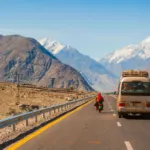

Few mountain passes carry as much history as the Khyber. Traders, armies and travellers have crossed it between Central Asia and the Indian subcontinent for centuries, and the road still runs from the edge of Peshawar to the Afghan border.
Visiting it is not as simple as turning up with a car. Parts of the route are open to view from the road, some sites are closed to the public, and visitors are generally expected to arrange permission in advance. This guide explains what the pass is, what there is to see, and what to confirm before you plan a trip.
Quick Answer
The Khyber Pass is a historic route in Khyber District, Khyber Pakhtunkhwa. It starts near Jamrud, about 18 km west of Peshawar, and climbs to Landi Kotal near the Afghan border. The pass proper is around 40 km long. Its most recognisable landmark is Bab-e-Khyber, the stone gateway at the entrance.
Foreign visitors are generally expected to obtain prior permission and travel with security, according to a 2024 travel account. Confirm the current arrangement with the Khyber Pakhtunkhwa authorities or an experienced Peshawar-based operator before you go.
Quick Facts
| Province and district | Khyber Pakhtunkhwa, Khyber District |
| Starts at | Near Jamrud, about 18 km west of Peshawar |
| Length | About 40 km from Jamrud to Landi Kotal |
| Highest point | Around 1,030 to 1,070 m (sources differ), near Landi Kotal |
| Main language | Pashto |
| Landmarks | Bab-e-Khyber, Jamrud Fort, Shagai Fort, Ali Masjid, Landi Kotal |
| Border point | Torkham |
History
The pass has been part of the Silk Road network and a major route between Central Asia and the Indian subcontinent. Many invaders and rulers crossed it, among them Darius I, Mahmud of Ghazni, Babur and Ahmad Shah Durrani.
In the nineteenth century, Sikh forces under Maharaja Ranjit Singh took the pass. General Hari Singh Nalwa built Jamrud Fort at its eastern entrance in 1836 and was killed defending it against an Afghan attack in April 1837. After the Second Anglo-Afghan War ended in 1880, the British controlled the region and relied on local tribes to keep the route open. The area became part of Pakistan in 1947. Khyber District was part of the former tribal areas until they merged with Khyber Pakhtunkhwa in 2018.
A railway line from Jamrud to the Afghan border near Landi Kotal opened in 1925. It later ran tourist steam trips, but recent accounts say the tourist service no longer operates.
What You Can See
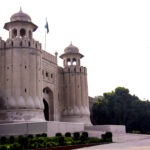
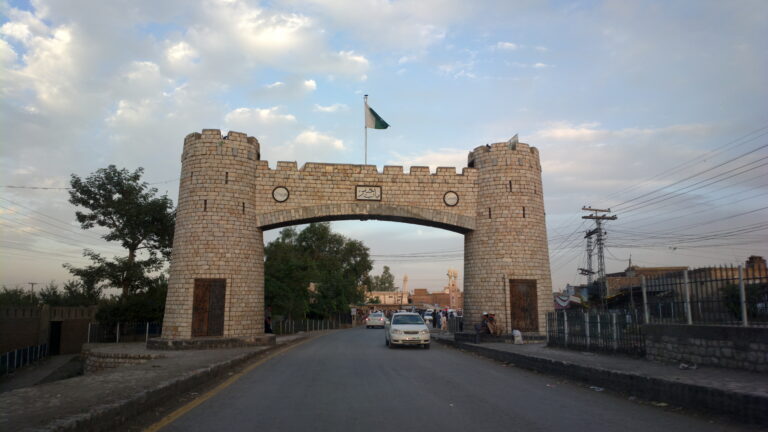
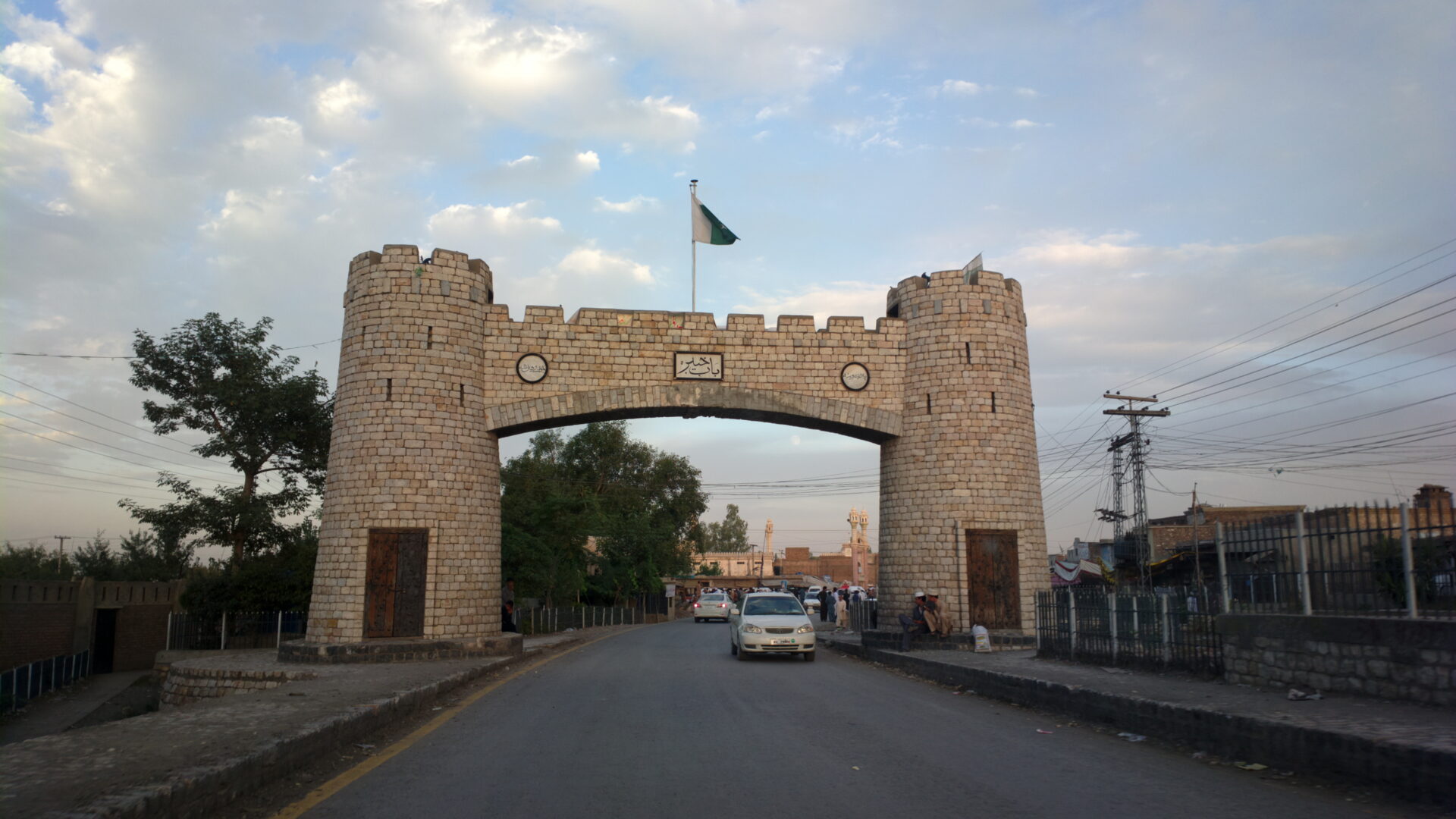
Bab-e-Khyber (Khyber Gate). A monumental gateway at the pass entrance, opened on 11 June 1963 by President Ayub Khan. It sits beside Jamrud Fort and appears on the ten-rupee note. It is the easiest landmark to see, because it stands on the roadside.
Jamrud Fort. Also known as Fatehgarh Fort. It is owned by the government and garrisoned by the Frontier Corps, and it is not open to the public. Plan to view it from outside only.
Shagai Fort. A British-era fort from the 1920s, now used by the army. Visitors can see it from the road, but access to the fort itself should not be assumed.
Ali Masjid. The narrowest point of the pass, with a small mosque and a hilltop fort. It is a good stop for understanding how defensible the pass was.
Landi Kotal. The last town on the Pakistani side and the headquarters of Khyber District. It is known for its busy markets and for chappal kebabs.
Torkham. The border crossing near the end of the road. It is a working border, and ordinary visitors do not go there unless they have a reason to cross.
Can Visitors Go?
Access is the main question, and the honest answer is that it depends on who you are and how you arrange it.
- A recent travel account says foreigners must have prior permission and be accompanied by security.
- Several of the sites, including Jamrud Fort, are military or government property and closed to the public.
- The rules are set by the authorities and can change. Do not rely on older blog posts.
For a practical approach:
- Contact a licensed Peshawar-based tour operator and ask whether day trips to the pass are currently permitted for your nationality.
- Ask what permission is needed and how long it takes.
- Plan the visit as a half-day or full-day trip from Peshawar.
- Carry your passport or CNIC and keep copies.
- Expect checkpoints and follow the instructions of the escort.
See our guides to hiring a guide in northern Pakistan and Pakistan tourism for foreigners for general advice, and the travel documents checklist.
How to Reach
The pass starts about 18 km west of Peshawar. Peshawar has road and rail links to Islamabad and Lahore, and it is the practical base for the trip. Our Peshawar travel guide covers hotels, food and the old city.
Because you will likely travel with an escort or an operator, public transport is not a realistic way to do the full route. If you do travel independently along the open sections, check for the latest rules at each checkpoint.
Best Time to Visit
Peshawar is hot in summer and mild in winter. October to March is the more comfortable period for an excursion. Landi Kotal is higher and cooler than Peshawar. Check the weather forecast on the day.
Photography and Etiquette
- Do not photograph military installations, checkpoints or personnel.
- Ask before photographing people, especially women.
- Dress modestly. Men and women should both cover shoulders and knees.
- Follow your escort’s guidance about where to stop.
Nearby Attractions
Peshawar has the Qissa Khwani Bazaar, Mahabat Khan Mosque and the Peshawar Museum, all of which make a natural pairing with a Khyber trip. Further afield, Takht-i-Bahi is a Buddhist monastery near Mardan.
Possible Itinerary
A day trip from Peshawar
- Morning: Leave Peshawar with your arranged escort and see Bab-e-Khyber and Jamrud Fort from the road.
- Midday: Continue to Shagai Fort and Ali Masjid, then to Landi Kotal for lunch.
- Afternoon: Return to Peshawar and spend the evening in the old city.
Schedule depends on what permission allows, so build in flexibility.
FAQs
Where is the Khyber Pass?
In Khyber District, Khyber Pakhtunkhwa, starting about 18 km west of Peshawar and running to the Afghan border.
How long is the Khyber Pass?
About 40 km from Jamrud to Landi Kotal.
Can tourists visit the Khyber Pass?
Visitors generally need to arrange permission in advance, and foreigners are expected to travel with security. Confirm current rules before going.
Can I go inside Jamrud Fort?
No. It is not open to the public.
What is Bab-e-Khyber?
A stone gateway at the pass entrance, opened in 1963.
Is there a train through the Khyber Pass?
A railway line was built in 1925, but recent accounts say the tourist train no longer runs.
Conclusion
The Khyber Pass is best understood as a history lesson that happens to be on a working road. You can read the story at Bab-e-Khyber, Ali Masjid and Landi Kotal, but you should settle permission and transport before you leave Peshawar. With the right arrangements it makes a strong half-day or full-day trip.
Sources and further reading
- Khyber Pass, Wikipedia
- Bab-e-Khyber, Wikipedia
- Jamrud Fort, Wikipedia
- Khyber District, Wikipedia
- Indus Caravan, Over the Khyber Pass (July 2024)