







Guru Nanak was born, travelled and died in what is now Pakistan. That is why the country holds some of the most important gurdwaras in the world, and why Sikh pilgrims from India, the UK, Canada and elsewhere travel here each year.
For anyone planning a visit, the sites are spread across Punjab rather than gathered in one place. Nankana Sahib is west of Lahore, Panja Sahib is near Islamabad, and Kartarpur Sahib is close to the border in Narowal district. This guide puts them in one route so you can see how the distances work, when the big gatherings fall, and which rules to confirm before you go.
Quick Answer
The three main Sikh holy sites in Pakistan are:
- Gurdwara Janam Asthan, Nankana Sahib: the birthplace of Guru Nanak, about 65 km from Lahore.
- Gurdwara Panja Sahib, Hasan Abdal: the shrine built around a boulder said to carry Guru Nanak’s handprint, about 40 km north-west of Islamabad.
- Gurdwara Darbar Sahib, Kartarpur: where Guru Nanak is said to have spent his last 18 years, a few kilometres from the Indian border in Narowal district.
Lahore also has Gurdwara Dera Sahib, which marks the martyrdom of Guru Arjan, but access there is limited (see below). The two big dates are Baisakhi in April and Guru Nanak Gurpurab in November.
Quick Facts
| Nankana Sahib | Panja Sahib | Kartarpur Sahib | |
|---|---|---|---|
| Province | Punjab | Punjab | Punjab |
| Nearest city | Lahore (about 65 km) | Islamabad (about 40 km) | Narowal; Lahore is roughly 130 km |
| Links to Guru Nanak | Birthplace | Handprint on the rock | Final years and passing |
| Managed by | Pakistan Sikh Gurdwara Prabandhak Committee | Pakistan Sikh Gurdwara Prabandhak Committee | Pakistan government complex |
| Big gatherings | Gurpurab (November) | Baisakhi (April) | Death anniversary (September) and Gurpurab |
Distances are approximate road figures. Check them on your map app before departure.
Gurdwara Janam Asthan, Nankana Sahib
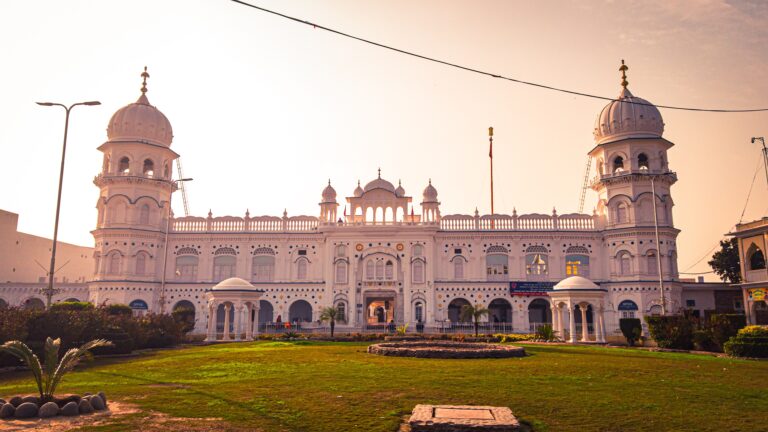
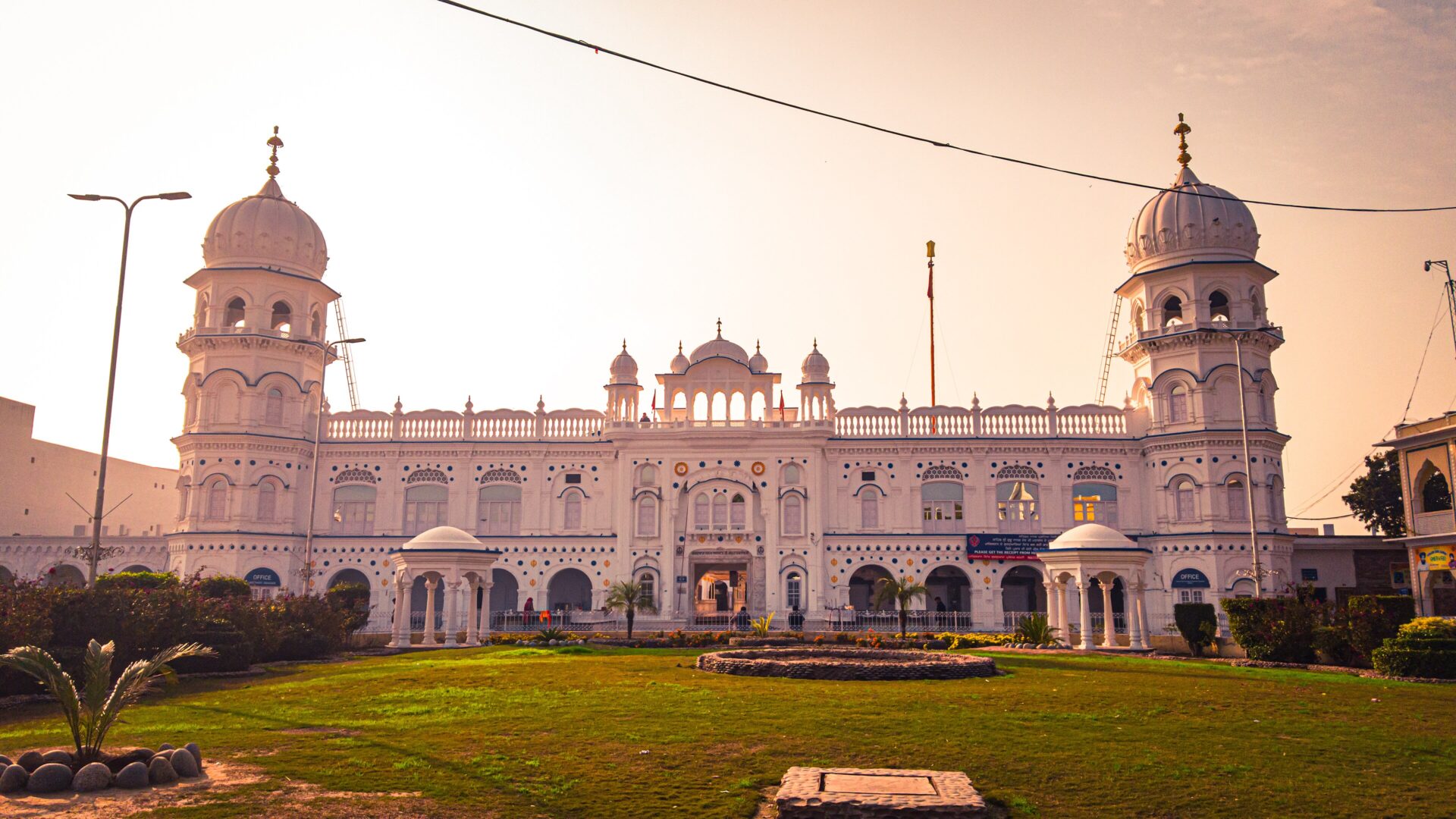
Nankana Sahib is a town of the same name in Punjab, around 65 km from Lahore. The gurdwara marks the place where Guru Nanak is believed to have been born. The present building dates to the early nineteenth century, built during the reign of Maharaja Ranjit Singh. It is listed as a protected heritage monument by the Government of Punjab.
The town contains nine gurdwaras linked to Guru Nanak’s life, so a visit can take more than one stop. The gurdwara is also tied to a painful chapter of the twentieth century: in February 1921, 86 Sikhs were killed here during a dispute over the management of the shrine. Visitors who want context will find it discussed in Sikh historical accounts.
If you only have one day in Punjab for Sikh heritage, Nankana Sahib is the most natural choice. It is close to Lahore, and the road is straightforward.
Gurdwara Panja Sahib, Hasan Abdal
Hasan Abdal sits where the Karakoram Highway meets the M-1 motorway, at the edge of Punjab and Khyber Pakhtunkhwa. Panja Sahib stands in the centre of town.
According to Sikh tradition, Guru Nanak and his companion Bhai Mardana came here in 1521. A local saint refused them water. Guru Nanak moved a rock and a spring began to flow. When the saint rolled a boulder down the hill, the Guru stopped it with his hand and left a print in the stone. Clear spring water now flows into a large pool beside the rock, and the gurdwara is built around it.
Hasan Abdal is also close to Taxila, so the two fit into one day trip from Islamabad. See our Taxila visit guide for the Buddhist sites nearby.
Gurdwara Darbar Sahib, Kartarpur
Kartarpur lies on the Ravi in Shakargarh tehsil, Narowal district. Guru Nanak is said to have founded the town and lived here until his death in 1539. The main shrine was built in 1925 with a donation from the Maharaja of Patiala, restored by the Pakistan government in 2004, and the complex was expanded across about 42 acres in 2018.
The complex now has a courtyard, museum, library, langar hall, a sarovar (sacred pool) and a well that pilgrims associate with the Guru’s time. Sikhs on the Indian side have long looked across to the shrine from a viewing spot near the border.
The Kartarpur Corridor. A dedicated corridor opened on 9 November 2019, letting Indian pilgrims reach the gurdwara visa-free on a day trip. Reports in September 2026 say India has kept the corridor closed since May 2025, and Sikh groups have been calling for it to reopen. From the Pakistan side, the gurdwara itself can still be visited by road. Confirm the current corridor and entry status with official sources before you plan around it.
Gurdwara Dera Sahib, Lahore
Gurdwara Dera Sahib stands just outside the Walled City, facing the Hathi Pol of Lahore Fort and close to Badshahi Mosque. It marks the place where Guru Arjan, the fifth Guru, died in 1606. It sits in the same cluster of monuments as the Samadhi of Ranjit Singh and the Tomb of Iqbal.
Access is more restricted here than at other sites. Sikh visitors can enter, while others are reported to need special permission from the Evacuee Trust Property Board. If you are visiting Lahore’s heritage cluster, plan to see it from outside unless you have arranged permission. Our guides to Lahore Fort and Badshahi Mosque and Shahi Qila cover the area.
When to Go: Baisakhi and Gurpurab
The two main gatherings are tied to the Sikh calendar, so confirm dates each year.
| Event | Usual timing | What happens |
|---|---|---|
| Baisakhi (Vaisakhi) | April, around the middle of the month | Harvest festival and pilgrimage, with prayers, langar and processions, especially at Panja Sahib and Nankana Sahib |
| Guru Nanak Gurpurab | November, on the full moon of Kartik | Birth anniversary of Guru Nanak, centred on Nankana Sahib |
In 2026, the Gurpurab date is listed as 24 November (Kartik Purnima). Local gurdwaras may mark it a day earlier or later, and the Akhand Path usually starts two days before. A group of pilgrims from Haryana is scheduled to travel from 22 November to 1 December 2026, with Nankana Sahib, Kartarpur, Dera Sahib and Panja Sahib on the list, according to Indian press reports.
If you are not on an organised pilgrimage, expect these weeks to be crowded and tightly managed. Roads near the gurdwaras may be restricted. A quieter visit is easier between October and March, when the weather in the Punjab plains is mild.
Who Can Visit
This is the most common question, and the honest answer is that it depends on who you are and which site you mean.
- Indian Sikh pilgrims travel in organised groups on special visas for events such as Baisakhi and Gurpurab. Approval comes from both governments and can change from year to year. In June 2026, for example, a group was turned back at the border over missing clearance.
- Sikh pilgrims from other countries and Pakistani Sikhs can visit under their own national rules. Overseas visitors need a Pakistani visa. See our Pakistan visa guide and travel documents checklist.
- Other visitors, including non-Sikh tourists: rules vary by gurdwara and by day. Some sites welcome visitors and others control entry. Ask the management or a local guide before you travel instead of assuming.
Where an entry fee applies, it should be checked locally. A 2022 traveller report gave PKR 200 for Kartarpur Sahib with entry between 9 am and 3 pm, but treat that as out of date.
How to Reach
| Site | From | Road | Notes |
|---|---|---|---|
| Nankana Sahib | Lahore | About 65 km | Easy day trip |
| Panja Sahib | Islamabad | About 40 km north-west, near the KKH and M-1 junction | Combine with Taxila |
| Kartarpur Sahib | Lahore | Roughly 130 km via Narowal | Allow at least a full day |
Public transport exists to all three towns, but a private car or a hired driver saves time on this route. Check current train and bus options through the usual channels. Our public transport guide and train travel guide explain the basics.
Lahore and Islamabad are the practical airports for this route.
Etiquette Inside a Gurdwara
The rules are simple and apply to everyone:
- Remove your shoes and cover your head before entering. Carry a clean scarf or handkerchief.
- Dress modestly, covering shoulders and knees.
- Do not bring tobacco or alcohol.
- Walk quietly and do not point your feet toward the Guru Granth Sahib.
- Ask before taking photographs, and avoid photographing worshippers praying.
- If you eat in the langar, accept what is served and finish what you take.
These follow the same spirit as our guide to mosque and shrine etiquette: respect the space, follow what the staff tell you.
Where to Stay and Eat
Pilgrims are usually housed in hostels attached to the gurdwaras during major events. Independent travellers normally stay in Lahore or Islamabad and travel out. See best hotels in Lahore and best hotels in Islamabad.
Langar is free and vegetarian at the gurdwaras. For restaurants, use the Lahore and Islamabad guides above.
Possible Itinerary
Option 1: Two days from Islamabad and Lahore
- Day 1: Islamabad to Hasan Abdal for Panja Sahib, then Taxila, then onward to Lahore.
- Day 2: Lahore to Nankana Sahib in the morning, back in the afternoon.
Option 2: Add Kartarpur
- Day 3: Lahore to Kartarpur Sahib via Narowal and back, leaving early.
Add a day in Lahore for Dera Sahib’s exterior, the Samadhi of Ranjit Singh and Lahore Fort.
Practical Notes Before You Travel
- Expect identity and bag checks at the larger gurdwaras, and carry your CNIC or passport. A 2022 traveller report described several checkpoints on the way into Kartarpur Sahib.
- Rules on cameras and bags can differ by site. Travel light and ask at the gate.
- Opening times and fees change. Confirm with the gurdwara management or a recent source before you leave.
FAQs
Where is Guru Nanak’s birthplace in Pakistan?
Nankana Sahib, in Punjab, about 65 km from Lahore.
What is Panja Sahib?
A gurdwara in Hasan Abdal built around a rock said to carry Guru Nanak’s handprint.
Is the Kartarpur Corridor open?
Press reports from September 2026 say India has kept it closed since May 2025. Check official sources before you plan.
When is Guru Nanak Gurpurab in 2026?
Calendars list 24 November 2026. Local gurdwaras may mark it a day earlier or later.
Can non-Sikhs visit these gurdwaras?
Rules differ by site. Dera Sahib in Lahore is reported to need special permission. Confirm with the management for the others.
Do I need a visa?
Overseas visitors do. Indian pilgrims travel on special arrangements between the two governments.
Conclusion
Pakistan’s Sikh holy sites make a route that is clear to follow: Panja Sahib near Islamabad, Nankana Sahib near Lahore, and Kartarpur in Narowal. The practical challenge is not distance but timing and entry rules, which change. Plan around Baisakhi or Gurpurab if you want the full atmosphere, and around the cooler months if you want space.
Sources and further reading
- Gurdwara Janam Asthan, Wikipedia
- Gurdwara Panja Sahib, Wikipedia
- Hasan Abdal, Wikipedia
- Gurdwara Darbar Sahib Kartarpur, Wikipedia
- Kartarpur Corridor, Wikipedia
- Gurdwara Dera Sahib, Wikipedia
- Dawn, 23 September 2026, on the Kartarpur Corridor
- The Tribune, 21 September 2026, on corridor status