









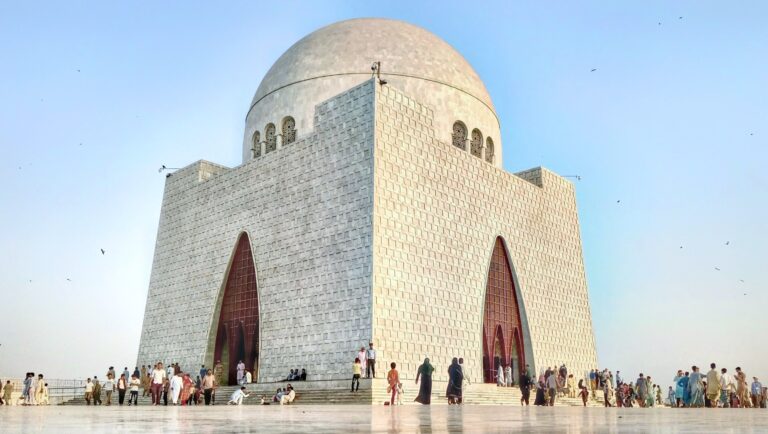
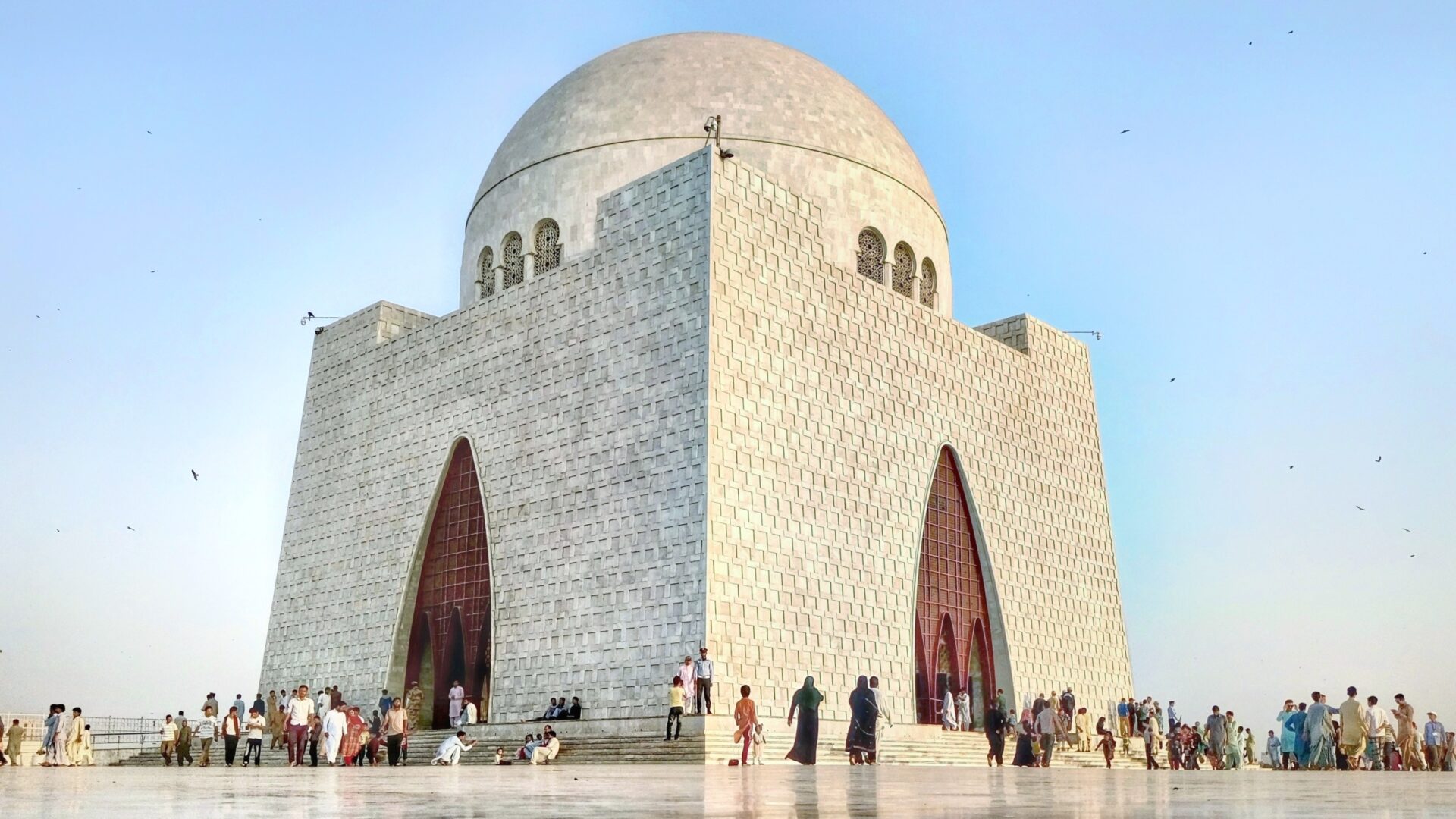
Mazar-e-Quaid is the white marble mausoleum of Muhammad Ali Jinnah, the founder of Pakistan. It stands in central Karachi and is also called the Jinnah Mausoleum or the National Mausoleum. Jinnah died on 11 September 1948. His tomb now sits on a raised site inside a large garden, and it is one of the most visited landmarks in the city. This guide covers the history, the design, how to visit, and what to see nearby.
Quick answer: what is Mazar-e-Quaid?
Mazar-e-Quaid is the national mausoleum in Karachi, Sindh. The Bombay-based architect Yahya Merchant designed it. President Ayub Khan laid the foundation stone on 31 July 1960, and the complex was formally inaugurated on 18 January 1971. It is about 43 metres high and clad in white marble. Jinnah’s sister, Fatima Jinnah, and several early national leaders are buried nearby. Visitors remove their shoes to go inside, so dress modestly and bring socks. Check the current hours and rules before you go.
Mazar-e-Quaid quick facts
| Detail | Mazar-e-Quaid |
|---|---|
| Location | Jamshed Quarters, at the end of M.A. Jinnah Road, Karachi, Sindh |
| Coordinates | 24.8754° N, 67.0408° E |
| Foundation stone | 31 July 1960 |
| Inaugurated | 18 January 1971 |
| Architect | Yahya Merchant |
| Height | About 43 m |
| Materials | White marble with copper grills |
| Style | Modernist, with Mughal touches |
| Also buried here | Fatima Jinnah, Liaquat Ali Khan, Nurul Amin, Abdur Rab Nishtar |
| Managed by | Quaid-e-Azam Mazar Management Board |
| Best season | November to February |
Where is Mazar-e-Quaid?
The mausoleum is in the Jamshed Quarters area of central Karachi. It sits along the northern edge of the old colonial core, at the end of Muhammad Ali Jinnah Road. A large garden surrounds it, and busy traffic circles mark three of its corners. The Quaid-e-Azam Mazar Management Board lists the main mazar area at about 61 acres.
History of Mazar-e-Quaid
After Jinnah died in 1948, his grave was marked by a large white marble slab on a plinth. Many Pakistanis felt the site deserved something grander. In 1949, the Quaid-e-Azam Memorial Fund was set up to plan a proper memorial.
Several designs were considered over the years. The management board’s own history says proposals from a Turkish, an Indian and a British architect were not approved. In the end, the work went to Yahya Merchant, a Bombay-based architect and a friend of Jinnah. Jinnah’s sister, Fatima Jinnah, wanted him for the job. He submitted his design in December 1959, and the committee approved it.
Ayub Khan laid the foundation stone on 31 July 1960. Building took about a decade. Many sources say the structure was finished around 1970, and it was formally inaugurated on 18 January 1971.
In November 2025, news reports said restoration work had begun on the marble dome, ahead of Jinnah’s birthday on 25 December.
Mazar-e-Quaid architecture and design
The mausoleum is modernist in form, with Mughal touches. It is clad in white marble and has curved arches and copper grills, all set on an elevated platform. Four pointed arches lead into an octagonal hall. A ceremonial sarcophagus sits in the centre. The actual grave is in a chamber directly below it.
Inside, a four-tiered crystal chandelier hangs in the central space. It was a gift from the People’s Republic of China. The garden around the tomb is laid out in a neo-Mughal style, with lawns and fountains.
Who is buried at Mazar-e-Quaid?
Muhammad Ali Jinnah rests in the main mausoleum. Nearby are the graves of Fatima Jinnah, known as Madar-e-Millat, or Mother of the Nation; Liaquat Ali Khan, Pakistan’s first prime minister; Nurul Amin, its eighth prime minister; and Sardar Abdur Rab Nishtar, a senior Muslim League leader.
How to reach Mazar-e-Quaid
The mausoleum is in the middle of Karachi and is easy to find. Most visitors arrive by taxi or ride-hailing car.
Nearest airport
Jinnah International Airport is Karachi’s main airport. It is some distance from the centre, so allow time for road traffic. Taxis and ride-hailing cars run from the terminal.
Nearest railway station
Karachi City Station and Karachi Cantonment Station are the main railway stations. Check Pakistan Railways for current timetables.
Road access
Follow Muhammad Ali Jinnah Road to its end. Traffic can be heavy, especially on national days. A ride-hailing car or taxi is usually easier than parking. Read our Public Transport Guide for Pakistan for other options.
Best time to visit
November to February is the most comfortable season. Karachi is warm and humid for much of the year. April to June can feel very hot. Monsoon rain between July and September can flood roads. Expect larger crowds and extra security around 25 December, Jinnah’s birthday, and 11 September, the anniversary of his death. For a wider view of seasons, see our Best Time to Visit Pakistan guide.
Weather
Karachi sits on the coast, so sea breezes cool the evenings. Days are warm and humid for most of the year. Winters are mild. Check the forecast, and carry water from March to October.
Places to visit
- The main mausoleum. Step inside to see the sarcophagus and chandelier.
- The nearby graves. Pay your respects at the tombs of Fatima Jinnah and other leaders.
- The garden. The lawns and fountains make a calm break from the traffic.
- The honour guard. Ceremonial guards stand at the tomb. Guard-change times vary, so ask on site.
Lesser-known details to look for
- The real grave lies in a chamber below the ceremonial sarcophagus.
- Look for the copper grill work set between the curved arches.
- The raised platform lifts the tomb above the surrounding streets.
- The chandelier, a gift from China, hangs in the central hall.
Things to do nearby
- Pay your respects and walk the garden at a slow pace.
- Learn more about Jinnah’s story. Our guide to the Quaid-e-Azam Residency in Ziarat covers another site tied to his life.
- Explore more of the city with our Karachi travel guide.
- Try Karachi biryani. See our guide to Pakistan’s best biryani.
Adventure activities
There are no adventure activities at the mausoleum. It is a place for quiet visits. For something active, head to the coast. See our guides to Pakistan’s beaches.
Photography spots
- Front view along M.A. Jinnah Road. This is the classic wide shot.
- Through the arches. Frame the garden and sky through the marble arches.
- The lawn at golden hour. The marble glows in late light.
- Detail shots. Try the copper grills and the marble texture.
Photography rules can vary inside the mausoleum. Ask the staff before you shoot, and do not photograph people at prayer. Flying a drone near national monuments usually needs official permission.
Where to stay
Karachi has hotels for all budgets. Central areas such as Saddar and Clifton put you within a short ride of the mausoleum. See our Travel Guide for Karachi for help choosing a base.
What to eat
Karachi is famous for biryani, kebabs and street snacks. Start with our biryani guide. Choose busy stalls and read our street food safety tips first.
Transportation
Ride-hailing apps and taxis are the easiest way to move around Karachi. Agree on the fare first if you hail a street taxi. Our public transport guide explains buses and trains.
Estimated costs (PKR)
Prices change often, so this page gives no fixed rupee amounts. Use the table as a planning checklist and confirm costs locally.
| Item | What to expect |
|---|---|
| Entry | Ask at the gate or check the management board’s website. Rules can change. |
| Ride from central Karachi | Varies by distance and traffic. Use the fare shown in the app. |
| Food and drink | Street food is usually the cheapest option. |
| Other sights | Museums and palaces have their own tickets. |
Packing checklist
- Modest clothing that covers shoulders and knees
- Socks, because marble floors can be hot
- Slip-on shoes that are easy to remove
- Water bottle, sun hat and sunscreen
- A copy of your ID
- Small cash for snacks and rides
Travel tips
- Visit in the morning or late afternoon to avoid the midday heat.
- Check hours first. The mazar management board sets them, and they can change. See the board’s website.
- Expect security checks at the entrance, as at most national sites.
- Avoid national days if you want a quiet visit.
- New to Pakistan? Read our 45 things to know before travelling to Pakistan.
Safety tips
- Traffic around the mausoleum is heavy. Cross with care and use crossings.
- Keep valuables out of sight, especially in crowds.
- Use registered taxis or ride-hailing apps after dark.
- Follow staff instructions, and avoid large political gatherings.
- For wider advice, see Is Pakistan Safe to Visit?.
Responsible tourism
- Dress modestly and keep your voice low.
- Remove your shoes where asked and follow staff instructions.
- Do not sit or climb on the graves or structures.
- Take your litter with you.
- Ask before photographing people, especially families paying respects.
Emergency contacts in Karachi
| Service | Number |
|---|---|
| Police | 15 |
| Edhi ambulance | 115 |
| Fire brigade | 16 |
| Rescue 1122 | 1122, where the service operates |
These numbers also appear in Canada’s travel advice for Pakistan. Save them before you travel.
Attractions nearby
- Frere Hall and Empress Market. Colonial-era landmarks in central Karachi.
- Mohatta Palace. A heritage palace in the Clifton area.
- Clifton seafront. A popular place to catch the sea breeze in the evening.
- More city ideas. See Exploring Karachi and Discovering Karachi.
Possible half-day itinerary
| Time | Plan |
|---|---|
| Morning | Visit Mazar-e-Quaid. Check opening times first. |
| Midday | Lunch in central Karachi, such as a biryani stop. |
| Afternoon | Frere Hall or Empress Market in the old city. |
| Evening | Sea breeze at Clifton, then dinner. |
Mazar-e-Quaid FAQs
Who designed Mazar-e-Quaid?
Yahya Merchant, a Bombay-based architect and friend of Jinnah, designed it.
When was Mazar-e-Quaid built?
The foundation stone was laid on 31 July 1960. Many sources say it was finished around 1970. It was formally inaugurated on 18 January 1971.
How tall is Mazar-e-Quaid?
About 43 metres.
Who is buried at Mazar-e-Quaid?
Muhammad Ali Jinnah is in the main mausoleum. Fatima Jinnah, Liaquat Ali Khan, Nurul Amin and Abdur Rab Nishtar are buried nearby.
Is there a dress code at Mazar-e-Quaid?
Dress modestly and cover your shoulders and knees. Shoes are removed before you go inside.
Is Mazar-e-Quaid free to enter?
We could not confirm a current fee. Check with the management board or at the gate.
What is the best time to visit Mazar-e-Quaid?
November to February, in the morning or late afternoon.
How long do I need at Mazar-e-Quaid?
One to two hours is enough for the mausoleum and garden.
Final thoughts on visiting Mazar-e-Quaid
Mazar-e-Quaid is a calm space in a busy city. It is also the best place in Karachi to connect with the story of Pakistan’s founder. Plan a morning visit, dress modestly, and confirm the hours before you go. For the official history of the site, see the Quaid-e-Azam Mazar Management Board.